
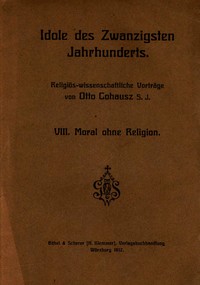
Idole des Zwanzigsten Jahrhunderts. VIII. Moral ohne Religion by Otto Cohausz
(5 User reviews)
1101
Cohausz, Otto, 1872-1938
German
"Idole des Zwanzigsten Jahrhunderts. VIII. Moral ohne Religion" by Otto Cohausz is a philosophical and theological treatise written in the early 20th century. The book discusses the concept of morality in a modern context, where religious values are increasingly rejected. Cohausz argues that without a divine basis for moral principles, society is l...
those of Christianity, and without this foundation, there is a chaotic array of conflicting moral philosophies. He critiques various modern ethical frameworks, emphasizing the need for an absolute norm of morality, which he argues can only be provided by God. The text ultimately defends the necessity of a theistic moral framework to guide human behavior, suggesting that true morality cannot exist independently of religious belief. Through his arguments, Cohausz warns of the consequences of separating morality from its divine origin, painting a picture of societal decay without a shared moral foundation. (This is an automatically generated summary.)
Carol Nelson
1 month agoSimply put, it creates a vivid world that you simply do not want to leave. It is definitely a 5-star read from me.
Michelle Scott
5 months agoAs someone who reads a lot, it serves as a poignant reminder of the human condition. Simply brilliant.
Linda White
4 months agoAfter looking for this everywhere, the translation seems very fluid and captures the original nuance perfectly. Highly recommended for everyone.
Elizabeth Brown
3 months agoTo be perfectly clear, the attention to historical detail adds a layer of realism that is rare. A perfect companion for a quiet weekend.
There are no comments for this eBook.






Steven Hall
5 months agoMake no mistake, the author's voice is distinct, making the complex topics easy to digest. Highly recommended for everyone.